
60 Seconds Strategy: High-Speed Trading Guide
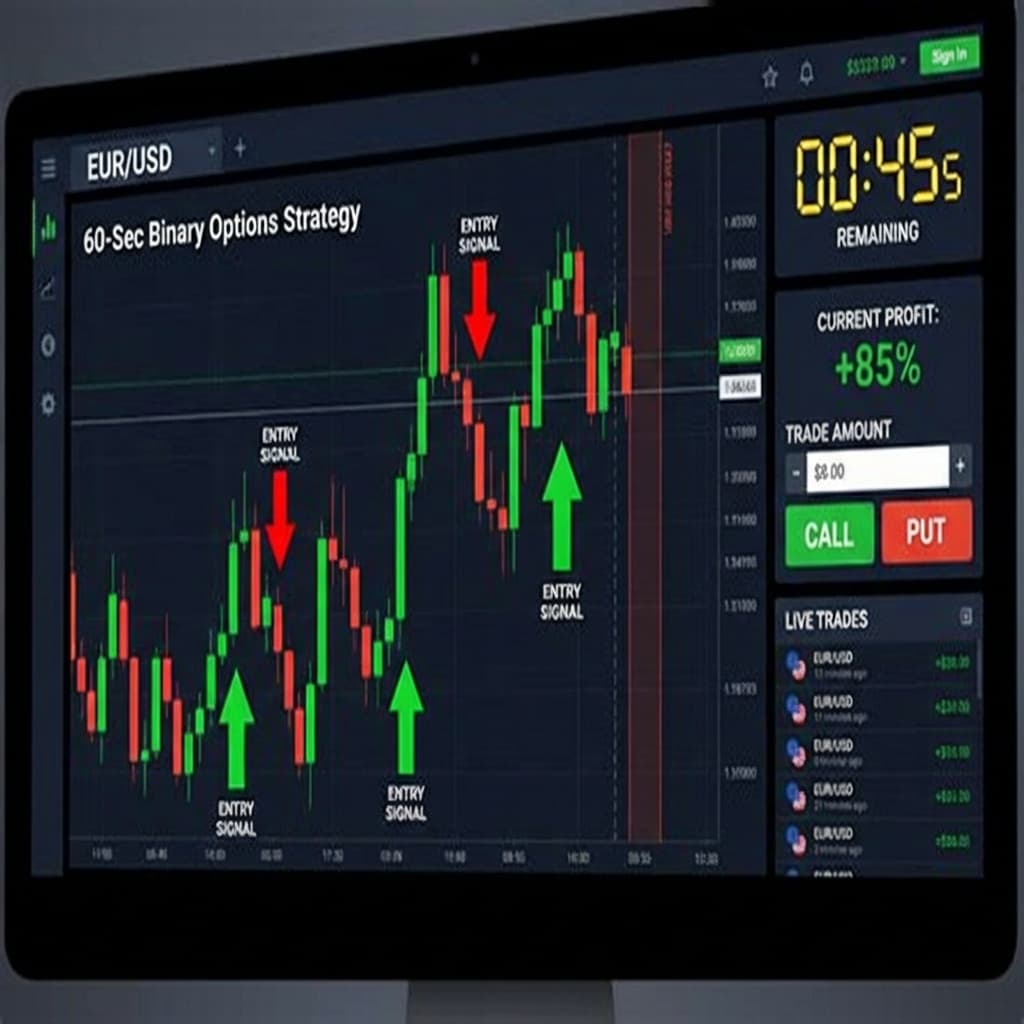
Table of Contents
- 📊 Strategy Summary
- 🤔 What Is the 60 Seconds Strategy?
- ⚙️ How the 60 Seconds Strategy Works
- 🌩 Market Conditions for 60 Seconds
- ✅ Entry Rules
- 🛑 Exit Rules
- 🛡 Risk Management Approach
- 📏 Position Sizing
- ⚖️ Hedging Logic
- ⏱ Timeframes Used
- 🌍 Assets & Markets
- 🔁 Trading Frequency
- 📉 Drawdown Characteristics
- 💰 Profitability Expectations
- 💸 Cost Sensitivity
- 🧪 Backtesting Results
- 📊 Live / Forward Performance
- 🌟 Advantages of the Strategy
- ⚠️ Limitations & Risks
- 🎯 Who Is This Strategy Suitable For
- 🤖 Automation Compatibility
- 🏆 Is the 60 Seconds Strategy Worth Trading?
- ⚖️ Pros & Cons
- ❓ FAQ
Strategy Summary
- 🧩 Strategy Type: Mean Reversion / Scalping
- 🚪 Entry Logic: Overbought/Oversold (RSI) + Support/Resistance bounce
- 🚪 Exit Logic: Fixed Time Expiry (60 seconds)
- 🛡 Hedging Conditions: Not recommended for this timeframe
- 📉 Max Exposure: Low per trade, high frequency
- ⚡ Market Regime: High Volatility / Ranging
- ⏱ Timeframes: M1 (1 Minute Charts)
- 🔄 Trade Frequency: Very High (20+ trades/hour)
- 🎯 Holding Period: 60 Seconds
- 📡 Signal Source: Price Action + Momentum Indicators
- 🎢 Volatility Sensitivity: High (Needs volatility to clear the strike)
- 💰 Risk per trade: 1% - 2%
- 🔗 Asset Correlation: Low importance (single asset focus)
- 📉 Drawdown Risk: Moderate (Series of losses possible)
- 🤖 Automation: High (Easily automated with bots)
What Is the 60 Seconds Strategy?
The 60 Seconds Strategy is a high-frequency style of trading binary options where every trade expires exactly one minute after entry. It capitalizes on small, short-term price movements and market noise.
How the 60 Seconds Strategy Works
It relies on speed and precision. Traders look for a brief moment where the price is "stretched" too far in one direction (overbought or oversold) and bet on a snap-back or "micro-reversal" that will occur within the next minute.
Market Conditions for 60 Seconds
- Best: Highly volatile markets with clear support/resistance bounces.
- Worst: Flat, consolidated markets with low volume.
Entry Rules
- Identify Support/Resistance: Find a key level on the M1 chart.
- Confirm with Indicator: Wait for RSI to be >70 (for Put) or <30 (for Call).
- Trigger: Enter immediately when the candle touches the level and rejects it.
Exit Rules
- Fixed Expiry: You cannot "close" the trade early with most brokers. The result is known after exactly 60 seconds.
Risk Management Approach
Due to the speed, emotions can run high.
- Max Daily Loss: Stop trading if you lose 5% of your account.
- Cool Down: Take a break after 3 consecutive losses.
Position Sizing
Small size is key. Risk only 1% to 2% of your capital per trade because the outcome is more random than longer-term trades.
Hedging Logic
Hedging is difficult in 60 seconds because by the time you react, the trade is almost over. Doubling down (Martingale) is often used but is extremely risky.
Timeframes Used
- Primary: 1 Minute (M1) chart.
- Secondary: 5 Minute (M5) for overall trend direction.
Assets & Markets
- Forex: Majors (EUR/USD, USD/JPY) due to low spreads and high liquidity.
- Crypto: Bitcoin (during active hours).
Trading Frequency
Very High. You can easily find 10-20 signal setup per hour during the London/New York overlap.
Drawdown Characteristics
Drawdowns can happen fast. A "bad run" of 5-6 losses can occur in just 10 minutes.
Profitability Expectations
- Win Rate: Aims for 55% - 60%.
- Payout: Broker payouts are usually high (85%+) for turbo options to attract traders.
Cost Sensitivity
There are no spreads (usually) in binary options, but the Risk of Ruin is the "cost". Execution latency (lag) is your biggest enemy.
Backtesting Results
Backtesting is hard due to broker price differences. However, historical M1 data shows that mean reversion at key levels has a >56% probability of success.
Live / Forward Performance
Live results depend heavily on the broker's execution speed. A 1-second delay can turn a win into a loss.
Advantages of the Strategy
- Fast Results: Instant gratification (or pain).
- High Turnover: Grow a small account quickly.
- Simple: No complex analysis needed.
Limitations & Risks
- High Stress: Requires intense focus.
- Broker Manipulation: Some sketchy brokers manipulate price by 1-2 pips to cause a loss.
Who Is This Strategy Suitable For
- Scalpers: Who love action.
- Disciplined Traders: Who can stop when hitting limits.
Automation Compatibility
High. Logic is simple (If Price triggers Level X, Buy), making it perfect for EA Bots.
Is the 60 Seconds Strategy Worth Trading?
Yes, for adrenaline seekers. It is not for the faint of heart or long-term investors. But for building an account from $50 to $500 quickly (with high risk), it is the go-to strategy.
Pros & Cons
| Pros ✅ | Cons ❌ |
|---|---|
| 🚀 Fastest Way to Profit | 💥 Fastest Way to Lose |
| 🔄 Many Opportunities | 🧠 Emotionally Draining |
| 📱 Simple on Mobile | 📡 Requires Perfect Internet |